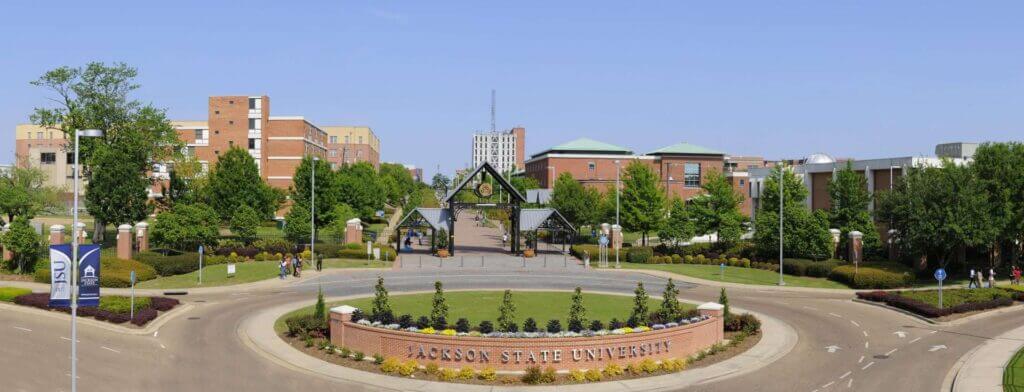
JACKSON, Mississippi — Jackson State University is among 15 Historically Black Colleges and Universities that launched the Association of HBCU Research Institutions, a national coalition designed to accelerate world-class research, expand institutional capacity and elevate HBCU leadership in addressing society’s most pressing challenges.
AHRI plans to increase research capacity, strengthen institutional infrastructure, boost funding opportunities, enhance faculty recruitment and expand student access to research and career pathways, leaders said. “AHRI represents a more coordinated approach to advancing HBCU research, and Jackson State University is proud to stand alongside peer institutions,” JSU President Denise Jones Gregory said.
“AHRI creates a stronger framework for institutions like Jackson State to build the systems that support research growth and translation,” Almesha L. Campbell, Ph.D., vice president for research and economic development at Jackson State, said. She said collaboration will expand access to federal funding, strengthen research infrastructure and create pathways for faculty and students to move ideas into application.
AHRI will work to increase the number of HBCUs achieving R1 Carnegie Classification. The group will co-locate offices with the Association of American Universities and is supported by a three-year, $1 million grant from the Harvard & the Legacy of Slavery Initiative, with technical assistance from Harvard’s Office of the Vice Provost for Research, officials said. Wayne A. I. Frederick, M.D., MBA, interim president of AHRI, said the coalition signals HBCUs’ leadership in research. Founding members include Howard University and 13 partner institutions such as Clark Atlanta University, Delaware State University, Florida A&M University, Hampton University, Morgan State University, North Carolina A&T State University, Prairie View A&M, Southern University, Tennessee State University, Texas Southern University, Virginia State University, South Carolina State University and Jackson State. Collectively, the institutions account for 50% of competitively awarded federal research funding among HBCUs.
AHRI launched its inaugural symposium, “Expanding the Research Mission of HBCUs,” to convene higher education leaders, policymakers and industry partners. Ruth Simmons, Ph.D., senior adviser to the Harvard president on engagement with HBCUs, called the association a “powerful new chapter” in HBCU research. AHRI leaders also urged government, corporate and philanthropic partners to invest in HBCU research and innovation. This is a developing story and will be updated as more details emerge.
Jon Ross Myers founded Mississippi News Group in 2013. Before founding the organization, he worked at The Daily Mississippian, The Marion Salute and The Southern Sentinel. A Mississippi journalist and writer based in Ripley, he received second place in poetry in the 2025 William Faulkner Literary Competition for "The Garden."
Stay connected
Mississippi, wherever you are.
Follow our coverage on Facebook and watch Mississippi News Group on YouTube.